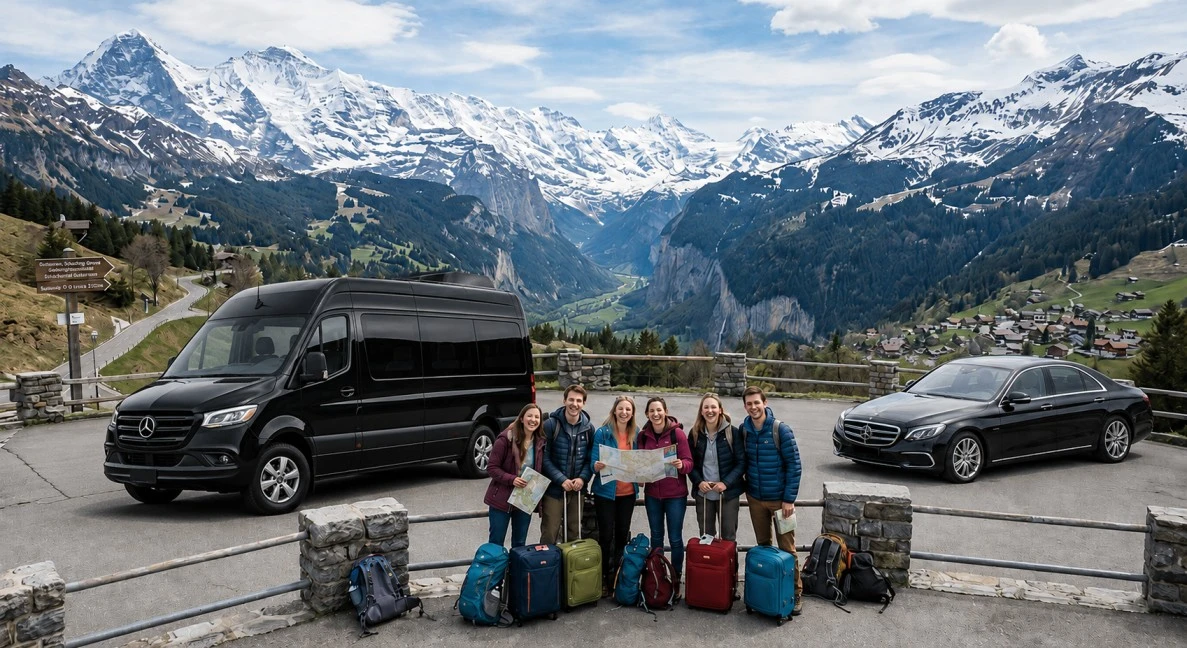
If you're planning a trip to Switzerland with more than four or five people, you'll hit this question fast: do you book one minibus, or split the group across two or three cars? It seems like a small logistics detail until you're actually standing at Zurich Airport with twelve suitcases, three kids, and a flight that landed an hour late. Then it becomes the decision that shapes your entire day.
We get asked this constantly at Zurich Taxi Transfer, usually by families heading to a wedding in Lucerne, corporate groups arriving for a conference, or tour groups starting a multi-day itinerary through the Alps. There's no single right answer, but there is a right answer for your situation. Here's how to figure out which one that is.
The Real Difference Isn't Just Seats
People assume this comparison comes down to headcount. A minibus and multiple cars can technically carry the same number of passengers, but the experience of traveling with each is completely different.
A minibus keeps everyone together. One driver, one route, one arrival time. If your uncle wants to stop for a coffee or your group needs five extra minutes to load luggage, that's a conversation with one driver, not a coordination effort across three vehicles with three different drivers who may not even speak the same language as each other.
Multiple cars, on the other hand, give you flexibility. If half your group wants to go straight to the hotel and the other half wants to detour to a pharmacy, you can split up without anyone waiting around. That flexibility has a cost too, which we'll get into.
When a Minibus Makes More Sense
For groups of six to sixteen people, a minibus is usually the more practical and more affordable choice, especially in Switzerland where distances between cities are short but roads through mountain regions can be winding and time-consuming.
It keeps the group together for the whole journey.
This matters more than people expect. Weddings, corporate retreats, and family reunions tend to have a schedule, and a schedule with one vehicle is far easier to manage than one that depends on three cars all leaving the airport, hotel, or venue at the same moment.
It's usually cheaper than booking three or four separate cars.
Switzerland isn't a budget destination on the best day, and taxi and transfer pricing reflects that. A single minibus transfer from Zurich Airport to somewhere like Lucerne or Zug will almost always cost less overall than the equivalent in multiple private cars, even before you factor in tipping multiple drivers.
Luggage stops being a puzzle.
Swiss trips often mean ski bags, golf equipment, or oversized suitcases for a longer stay. A minibus has the dedicated space to handle this without anyone holding a bag on their lap for an hour through the mountains.
One driver who knows the route.
For groups unfamiliar with Switzerland's road network, especially through areas like the Gotthard or the roads around Interlaken, having one experienced local driver instead of three separate ones reduces the chance of anyone getting lost, missing a turn, or ending up on the wrong side of a lake.
The trade-off is that a minibus needs everyone to be ready at the same time. If your group tends to run on different schedules, that's worth thinking about before you book.
When Multiple Cars Are the Better Call
Splitting into separate vehicles isn't a downgrade. In certain situations, it's genuinely the smarter move.
Groups larger than sixteen.
Once you're past what a standard minibus can comfortably hold, you're looking at a coach or multiple vehicles anyway. At that point, two well-timed minivans or cars often beat one oversized coach for maneuvering through smaller Swiss towns, many of which have narrow streets that weren't built with tour buses in mind.
Different destinations or drop-off times.
If part of your group is heading to a hotel in central Zurich and another part is continuing on to Basel or Bern the same day, separate cars remove the need for one group to sit and wait while the other is dropped off first.
VIP or business travel with mixed schedules.
Corporate groups often have executives on tighter timelines than the rest of the team. Splitting into cars lets key people move independently without holding up, or being held up by, everyone else.
Comfort preferences.
Some travelers, especially on longer routes like Zurich to Zermatt or Zurich to St. Moritz, simply prefer the space and privacy of a private car over a shared minibus, even within the same travel party.
The downside is cost and coordination. Multiple bookings mean multiple confirmations, multiple pickup points, and more room for something to go slightly wrong with timing.
A Quick Way to Decide
If your group is traveling together, arriving and leaving at the same time, and has a reasonable amount of luggage, book a minibus. It's simpler, generally more cost-effective, and reduces the number of moving parts you need to manage on a trip that's already got enough moving parts.
If your group is large enough to need more than one vehicle regardless, has different final destinations, or includes people who need to travel on separate schedules, multiple cars will serve you better, even with the added coordination.
A rough guideline we give clients:
◆ 1 to 4 people: standard car or van
◆ 5 to 8 people: minibus or two standard cars, depending on luggage
◆ 9 to 16 people: minibus is almost always the better value
◆ 17+ people or split destinations: multiple vehicles or a coach, arranged as a coordinated fleet
What This Looks Like Around Zurich
Most of our large group bookings fall into a handful of common routes: Zurich Airport to hotels in the city center, transfers out to Lucerne or Interlaken for day trips, and longer runs down to ski regions like Verbier, St. Moritz, or Zermatt during winter. On the shorter, city-based routes, a minibus almost always wins on both price and convenience. On the longer alpine routes, especially in winter when road conditions matter more, a lot of groups choose to split into two smaller vehicles simply because it's easier for the drivers to navigate mountain roads and easier for passengers to manage a long ride comfortably.
If you're arriving with a mixed group, some staying in Zurich and others continuing straight to the mountains, it's worth booking these as two separate transfers rather than trying to force everyone into one long combined trip. It usually works out both cheaper and less exhausting for everyone involved.
Booking Ahead Matters More in Switzerland Than People Expect
Switzerland doesn't have a huge surplus of minibuses and larger vehicles sitting idle, especially during ski season, major conferences, or summer festival months. If you know you're traveling with a group of eight or more, it's worth locking in your transfer well ahead of time rather than assuming you can arrange it a day or two before arrival. This is especially true for airport pickups, where flight delays and last-minute vehicle availability can turn into a stressful combination if nothing was booked in advance.
Frequently Asked Questions
How many people fit in a standard minibus in Switzerland?
Most minibuses used for transfers comfortably seat between eight and sixteen passengers, depending on the model and how much luggage space is needed alongside seating.
Is a minibus cheaper than booking two taxis in Switzerland?
In most cases, yes. A single minibus transfer typically costs less than two separate taxis covering the same route and passenger count, particularly on longer distances like airport-to-city transfers.
Can a minibus handle Switzerland's mountain roads?
Yes, minibuses regularly travel routes through the Alps, including to destinations like Zermatt, St. Moritz, and Interlaken. Experienced local drivers are familiar with seasonal road conditions and winter driving requirements.
What's the best transfer option for a group of ten from Zurich Airport?
A minibus is generally the best fit for a group of ten, offering enough seating and luggage space while keeping the group together for a single, coordinated pickup.
Should a large group split into multiple cars for a wedding transfer?
Only if guests are arriving from different locations or need to leave at different times. If everyone is on the same schedule, one minibus is usually simpler to coordinate and easier on the budget.
- Professional Service
- Always on Time
- Always on Time
| Street address | |||
| City | |||
| State | Zip code | ||
| Country | |||
| Street address | |||
| City | |||
| State | Zip code | ||
| Country | |||
| Street address | |||
| City | |||
| State | Zip code | ||
| Country | |||
Recent Posts
- Chauffeur Excellence: Unveiling the Art of Professional Chauffeur Services
- Switzerland’s Best Lakes to Visit in Summer
- The Journey: Zurich to St. Moritz - A Scenic Alpine Adventure
- Revealing Magnificence: The Top 10 opulent Davos Hotels
- Geneva's Top 15 Must-Visit Places
- Gateway to the Jungfrau: Luxury Zurich to Interlaken Transfer
- Top 5 Luxury Hotels in Geneva: Pair Your Stay with Geneva Limousine Service
- Zurich to Basel Private Taxi Transfer for Special Occasions & Events
- Swiss Fintech Week 2026 Zurich: Your Guide to Private Transfer Options
- Geneva Airport Transfer: Your Comprehensive Guide to Stress-Free Travel
- Top-10 Must-visit Museums in Madrid, Spain
- A Travel Guide To Germany - Quick Facts To Know About Germany
- Best Places To Stay In Zurich - Neighborhood And Surrounding Areas
- An Ultimate Guide to Europe's Top and Busiest Airports By Noble Transfer
- Friedrichshafen, Germany Travel Guide - Top Attractions and Hotels To Stay